.jpg)



Roof Claims: What Gets Paid, What Doesn't, What Gets Paid Halfway (And Why That Matters)

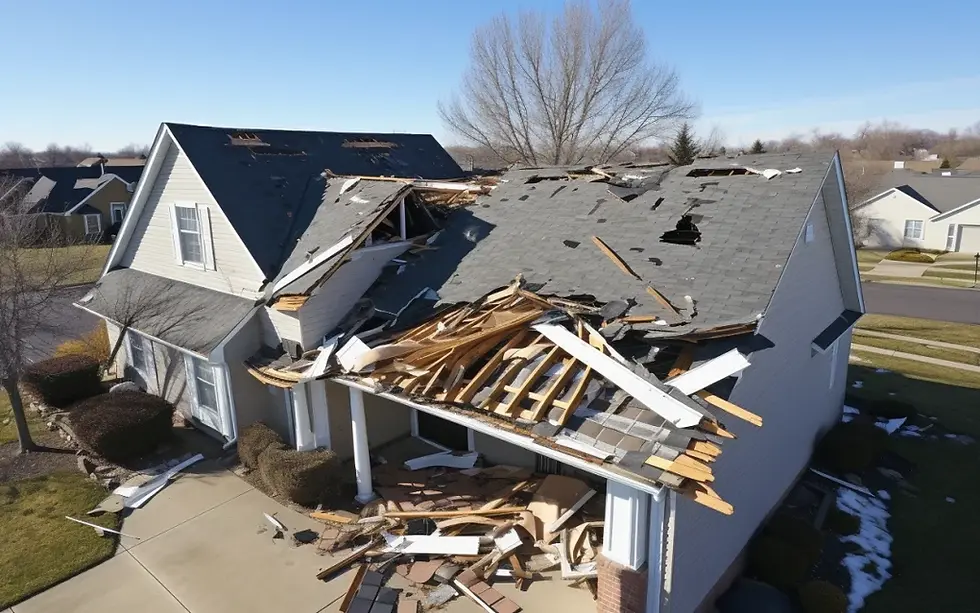
Roof claims look simple on the surface. Wind or hail hits a home, the roof gets damaged, the insurance company sends an adjuster, a check gets cut. In practice, roof claims are one of the most commonly underpaid categories of residential property claims — not usually because of outright denial, but because of how carriers scope, calculate, and quietly limit what they pay. Understanding the difference between what's fully paid, what's excluded, and what's paid "partially" is where most homeowners lose real money without ever realizing it.
What Typically Gets Paid
When a roof loss is a covered peril — wind, hail, a fallen tree limb, fire — the base repair or replacement of the damaged roofing system is usually paid without much of a fight:
Removal and disposal of damaged shingles or roofing material
Replacement shingles/materials matching the damaged area (subject to matching disputes, discussed below)
Underlayment directly damaged during the loss
Flashing that was damaged in the event
Emergency tarping to prevent further damage
This is the "obvious" part of the claim — the part carriers rarely dispute the existence of, even if they dispute the scope or pricing.
What Typically Does NOT Get Paid
Pre-existing wear and tear. If a roof was already at the end of its useful life, carriers will often argue the damage — or a portion of it — reflects deterioration rather than the covered event, and deny that portion outright.
Cosmetic-only damage on certain policies. Some carriers, particularly in wind/hail-prone regions, have cosmetic damage exclusion endorsements that specifically exclude paying for shingles that are dented or granule-scuffed but not functionally compromised — even if an adjuster's eye can clearly see hail impact marks.
Maintenance items unrelated to the loss. Gutters, vents, or flashing that were already failing before the loss but weren't part of the actual damage event.
Full roof replacement when only partial damage occurred — unless code, matching requirements, or manufacturer specifications require otherwise (more below).
What Gets Paid PARTIALLY — This Is Where Most Money Gets Left on the Table
This middle category is where roof claims are won or lost, and it's almost always invisible to a homeowner reading a carrier's estimate line by line.
Matching disputes. If shingles on one slope are damaged but the exact product is discontinued or a close color match isn't available, most state regulations (including here in Massachusetts, Rhode Island, and Connecticut) require reasonable matching — which can mean the carrier owes replacement of an entire elevation, or the entire roof, not just the damaged slope. Carriers routinely scope only the damaged slope and let the matching argument go unmade unless someone pushes back.
Code upgrade items. Under 780 CMR (Massachusetts) and the RI State Building Code, a roof replacement often triggers requirements for ice and water shield, proper drip edge, and ventilation corrections that didn't exist — or weren't required — when the roof was originally installed. Carriers frequently omit these unless the policy's Ordinance or Law coverage is specifically invoked and the code citation is put in front of them.
Waste factor. Roofing material can't be purchased and cut with zero waste. Manufacturer specifications and roof geometry (hips, valleys, dormers) typically justify a 15–20% waste factor — but initial carrier estimates often apply a flat, low waste percentage that doesn't reflect the actual roof's complexity.
Overhead and profit (O&P). When a roof job involves coordinating multiple trades — roofing, gutters, siding repair, interior water damage from the same event — the contractor is entitled to overhead and profit on the full job. Carriers sometimes try to pay O&P only on a portion of the work, or omit it entirely if they've decided (often incorrectly) that only one trade is involved.
Detach and reset items. Gutters, solar panels, satellite dishes, and other roof-mounted fixtures often need to be detached and reset to complete the work properly — a line item that's easy for an initial estimate to miss.
Permit fees. Roofing permits are required in most Massachusetts and Rhode Island municipalities, at actual fee-schedule cost — another line item that's commonly left off a first-pass carrier estimate.
This is where the stress is, you expected full replacement but your carrier is only paying for a patch or slope. Leaving money on the table.
Why Roof Claims Specifically Need a Public Adjuster
Roof claims are deceptively technical. The damage itself might be straightforward to see, but the coverage analysis behind it — matching statutes, code-upgrade triggers, manufacturer waste specifications, and O&P entitlement — is exactly the kind of detail that separates a fairly paid claim from an underpaid one.
A few reasons this category in particular benefits from a public adjuster:
The carrier's adjuster works for the carrier. Their estimate reflects the carrier's interest in minimizing the payout — not maliciously, but structurally, since they're not the ones climbing the roof arguing for reasonable matching or a code citation.
Matching law is jurisdiction-specific and rarely self-enforcing. Most homeowners don't know their state has a matching statute or regulatory guidance at all, let alone how to cite it in a claim negotiation.
Waste factor and O&P disputes are won with documentation, not opinion — roof geometry measurements, manufacturer specs, and trade-coordination evidence make the difference, and that's exactly the kind of documentation-heavy work a public adjuster builds into every estimate.
A denied "cosmetic damage" claim isn't always the end of the story. Depending on policy language and the specific facts of the loss, there are often legitimate grounds to push back on a cosmetic exclusion determination — but only if someone reviews the actual endorsement language rather than accepting the denial letter at face value.
Timing matters. Roof damage that isn't properly documented immediately can be harder to attribute cleanly to a specific storm event months later — a public adjuster helps make sure the claim is built correctly the first time, rather than trying to reconstruct it after a lowball offer has already been issued.

The Bottom Line
A roof claim isn't just "the roof gets fixed or it doesn't." It's a layered negotiation involving matching law, building code, manufacturer specifications, and contractor economics — and the gap between a carrier's first offer and what a policy actually owes is often measured in thousands of dollars, not hundreds. If you've had a roof claim paid, denied, or partially paid and you're not sure whether the number you got is the number you were owed, that's exactly the kind of thing worth a second look before the claim is closed for good.



Comments